🏆 The Only Solo Award-Winning Project @ Universiti Malaya Hackathon 2025
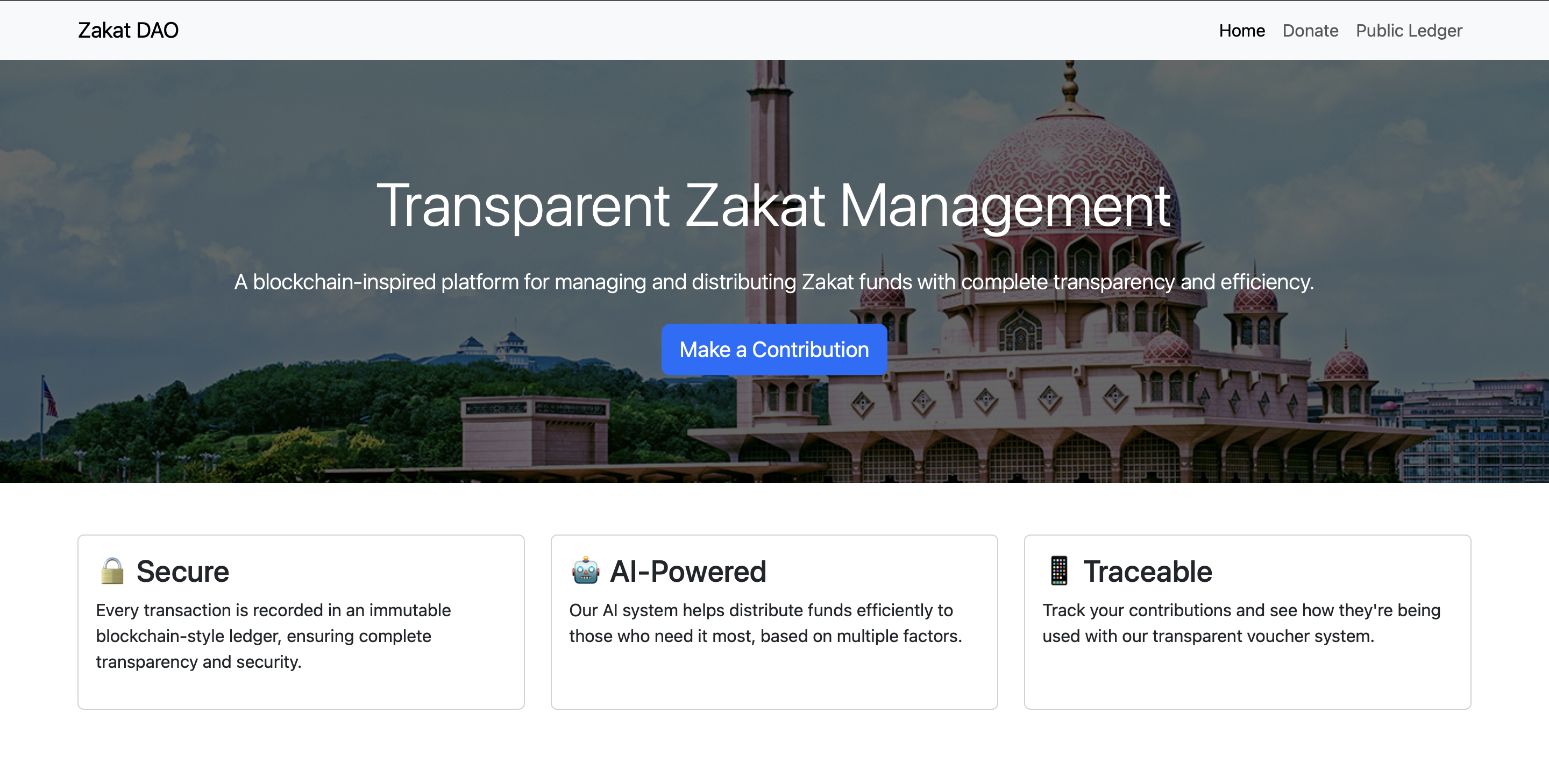
ZakatDAO is a decentralized platform designed to modernize how zakat, the Islamic obligatory almsgiving, is collected, governed, and distributed. Traditional zakat institutions often face challenges around transparency, efficiency, and reaching underserved asnaf (eligible recipients). ZakatDAO addresses these directly using blockchain, DAO governance, and AI-driven prioritization.
Why Decentralize Zakat?
Zakat distribution in many regions is managed by centralized bodies with limited public auditability. Donors often don't know how funds are allocated, and the process for asnaf to claim entitlements can be slow and opaque. A blockchain-based system changes the trust model: rules are encoded in smart contracts, every transaction is on-chain and auditable, and decisions pass through community governance rather than a single authority.
Architecture
DAO Governance -- Stakeholders vote on distribution policies, priority weights, and eligible recipient categories. No single administrator can unilaterally redirect funds. Proposals are submitted on-chain, voted on, and executed automatically when quorum is reached.
xAI Prioritization -- An AI layer analyses recipient applications and scores urgency based on need indicators (family size, income, health status). The scoring model is explainable; every decision comes with a plain-language rationale, which is essential for Shariah compliance where arbitrary algorithmic decisions are not acceptable.
Smart Contract Settlement -- Approved distributions execute automatically. The ledger is public, immutable, and independently verifiable by anyone, whether donors, regulators, or the asnaf themselves.
Shariah Compliance Layer -- Distribution rules and eligible asnaf categories (fakir, miskin, amil, gharimin, etc.) are hardcoded as governance parameters, not arbitrary logic. Scholars or a board can propose amendments through the DAO, maintaining institutional legitimacy.
Universiti Malaya Hackathon 2025
ZakatDAO was built solo and won the only individual award at the Universiti Malaya Hackathon 2025, recognized for its innovative application of decentralized technology to a real and underserved social finance problem. The judges highlighted the combination of technical depth (on-chain governance, AI prioritization, and Shariah-compliant design) delivered end-to-end by a single developer in hackathon time.