A Web3 payment is not complete when a transaction is submitted. The backend still needs to match the request, check the chain result, and decide when the payment is safe to settle. This is a public case-study draft, so product-specific business details stay private.

The system still needs to know what payment was requested, which network and token were used, whether the blockchain confirmed it, and whether the same payment has already been processed before.

The main idea

A Web3 payment moves through a few different systems before it can be treated as successful. It starts as a payment request, becomes an on-chain transaction, and only becomes a settled payment after the backend verifies the blockchain result.

This matters because the user interface can see a transaction before the backend has enough evidence to credit a balance, release an item, or tell a merchant that the payment is complete.

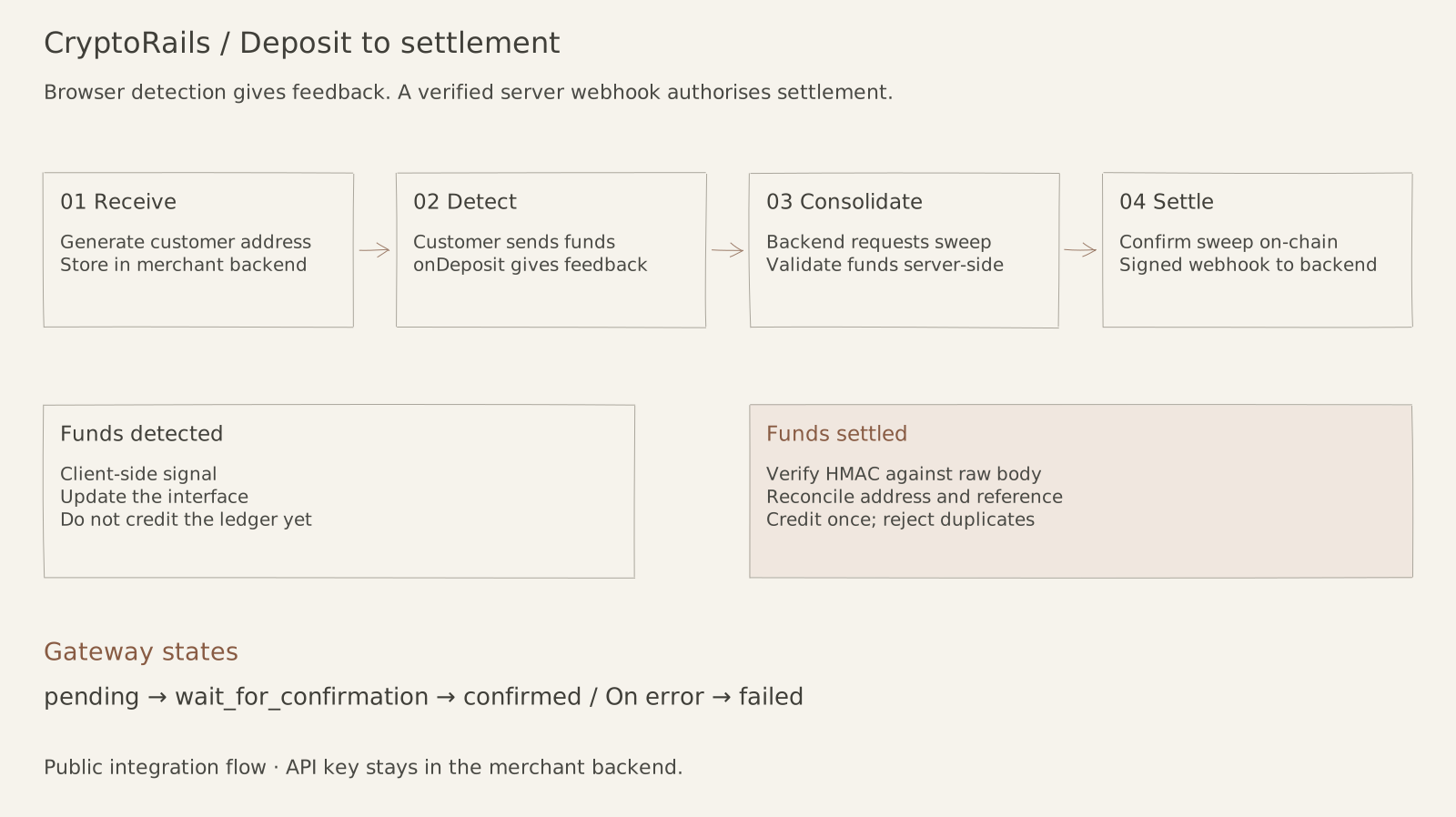
The public CryptoRails documentation describes the same principle in a practical way. A client-side deposit signal can be used for an immediate experience, but the verified server webhook is the authoritative signal for settlement.

The transaction lifecycle

Web3 payment transaction lifecycle state machine

Client detection can start the experience. Verified confirmation settles the payment.

The diagram is a state machine because the important part is not only the order of events. It is also the boundary between a transaction that is still being processed, a transaction that failed, and a transaction that is authoritative enough to settle.

1. Payment intent is created

The first step is creating a payment request. This can come from a merchant or from the user, depending on the product flow.

The system records the amount, token, network, recipient, and expiry time. It also creates a unique payment reference so that the request can be followed across the rest of the system.

This reference is important. A transaction hash identifies something on the blockchain, while the payment reference connects that blockchain activity back to the original business request.

2. Payment details are validated

Before the user signs anything, the system should validate the details that it can already know,

  • the network is supported;
  • the token is configured for that network;
  • the recipient address is correct;
  • the amount is still valid;
  • the payment has not expired.

This is where the system can reject a wrong network or unsupported asset early. It is much easier to explain a validation error before a transaction is signed than after funds have already moved.

3. The user interacts with a wallet

The user connects or selects a wallet and reviews the payment details. The amount and destination should be visible enough for the user to understand what they are signing.

The wallet then signs the transaction. At this point, the system has a signed transaction, but it does not yet have a confirmed payment.

4. The transaction is submitted

The signed transaction is broadcast to the selected blockchain. The system records the transaction hash and changes the payment state to something like submitted or pending.

For backend operations, the gateway documentation describes a more specific lifecycle, pending, processing, confirmed, or failed. The exact names can vary between products, but the idea is the same, submission and confirmation are different states.

5. The blockchain is monitored

The system checks the blockchain or an indexing service for the transaction. It needs to distinguish between a transaction that has not appeared yet, one that is still being processed, one that failed, and one that has been confirmed.

The interface should turn these technical states into useful messages. “Waiting for the network” is more understandable than showing a raw RPC response, while still being honest that the payment is not complete yet.

6. Confirmation and finality are reached

The system waits for the required confirmation condition before treating the transaction as successful. This condition may differ between EVM networks and TRON, so the exact rule should be defined by the implementation rather than assumed from the user interface.

The important invariant is simple, a submitted transaction is not the same as a confirmed transaction. Only the required confirmation condition should move the payment into a final successful state.

7. The payment is reconciled

After confirmation, the backend matches the blockchain result to the original payment reference. It checks the recipient, token, network, amount, and transaction hash.

The backend also needs to protect against duplicate processing. If the same deposit or transaction is observed more than once, the customer should not receive credit twice. The public documentation also recommends reusing the same transaction reference when retrying a write so that the operation remains idempotent.

8. The result is sent to the product

Once the transaction has been verified, the system updates the payment status and sends the result to the relevant product or merchant.

CryptoRails uses a signed webhook for this settlement event. The receiving backend should verify the HMAC signature against the raw request body before trusting the payload. This gives the product a server-side signal that can be used for ledger crediting, releasing goods, or showing a final success state.

The client-side signal still has value. It can show the user that funds have been detected quickly, but it should not be treated as proof of settlement by itself.

Where the lifecycle can fail

The happy path is not the whole system. Some of the cases that need a clear outcome are,

  • wrong network or unsupported token;
  • underpayment or overpayment;
  • expired payment request;
  • failed transaction;
  • delayed or dropped transaction;
  • duplicate transaction or duplicate webhook;
  • wallet rejection or user interface error;
  • blockchain RPC or indexing delay.

These cases do not all mean the same thing. Some need a retry, some need a manual review, and some should be rejected permanently. The product should make this distinction visible instead of placing every problem into one generic “failed” state.

EVM and TRON considerations

The gateway supports multiple blockchain labels, including EVM networks and TRON networks. The broad lifecycle remains the same across them, but the implementation details are not identical.

The parts that need to be handled carefully are,

  • address format and wallet compatibility;
  • correct network selection;
  • token and native-coin configuration;
  • transaction monitoring and indexing;
  • confirmation and finality rules;
  • fee or resource assumptions;
  • retry and error behaviour;
  • QA coverage for both successful and failed flows.

I am leaving the exact confirmation counts and chain-specific fee rules out of this draft until they are confirmed against the implementation. Those details should not be guessed in a public case study.

My contribution

My role sat between the business owner and the delivery team. I contributed to the product backlog and roadmap, ran Scrum ceremonies, and coordinated an eight-person team.

I also helped translate product priorities into technical requirements and coordinated work across the payment flows, EVM and TRON integration, QA, and UI/UX testing.

I kept the business question tied to the technical state of the system. A payment status affects what the user sees, what the merchant believes, and what the team needs to test.

Quality and delivery

I helped make sure that requirements were clear before implementation started. We also needed to check that the payment states were understandable to users and that the interface matched what was actually happening on-chain.

QA therefore needed to cover both successful and unsuccessful paths. A transaction that confirms is important, but so is a transaction that is late, rejected, sent to the wrong network, or received twice.

Keeping the business owner, product work, engineering work, QA, and UI/UX discussions aligned helped reduce the gap between the payment lifecycle in the system and the payment lifecycle experienced by the user.

Wrap-up

The payment moves from intent, through wallet interaction and blockchain confirmation, into reconciliation and final notification. That sequence turns a submitted transaction into a settled payment.

Client-side detection can start the experience. Verified server-side confirmation controls settlement.

This case study covers the general transaction lifecycle and my responsibilities. Product-specific business details, implementation details, and performance results remain confidential.

For the public technical reference, see the CryptoRails payment gateway documentation, especially the integration guide, transaction overview, and webhook documentation.

Some parts are still open for now, which is okay, I suppose.