YC Labs’ experiments with AI agents in games reminded me of the multi-agent reinforcement learning (MARL) I used to study. I liked that I could follow what the agents did, mistakes included.
Minecraft: a civilisation in three hours
In one run, 50 agents had three hours to build a civilisation. They formed a hierarchy, rationed food, and sent about 5,900 messages. After a hard first night, they grew cautious and sheltered more. Their shared files held food queues and rules about who could take supplies.
One detail stayed with me: an agent picking up food did not mean the recipient had it. The agents had to check who had eaten before calling a delivery complete.
This is a software handoff problem. A message saying a task is done can drift from the actual state, and the next agent may act on the message without checking. When several agents rely on the same wrong report, a small error spreads.
Competitive games: Bed Wars and Mindustry
YC also recorded competitive Minecraft games, such as Bed Wars.
In Mindustry, teams competed. YC reported that the GPT agents split ownership into smaller pieces, while the Claude agents relied more on a leader. The GPT team won the seven-game series 6–1. That score describes this setup, not how the models compare on other tasks. See the interactive Mindustry replay.
The replays make the coordination easy to follow. A team must divide responsibilities, share resources, and react when a plan fails. Those choices shape what each agent can do, even with one shared objective.
Why MARL felt harder
What made MARL hard for me was that an agent’s best action depends on what the others do, while they are also learning and changing.
Game theory describes incentives, strategies, and equilibria. MARL adds how agents learn to act from experience, often with incomplete information, so there is a learning process to account for as well as a solution. That was the part I found more involved. Game theory itself can be extremely difficult; I am comparing with fixed optimisation, not ranking the two subjects.
In simple optimisation, the objective and constraints are fixed and you search for a good solution. In a multi-agent setting, an action’s outcome depends on other agents’ actions, and in MARL those agents may adapt at the same time. A strategy that beat yesterday’s behaviour may fail against today’s.
An equilibrium describes a relationship between strategies. It does not explain how agents with limited observations and finite experience reach it; exploration, learning rules, and information all shape that path.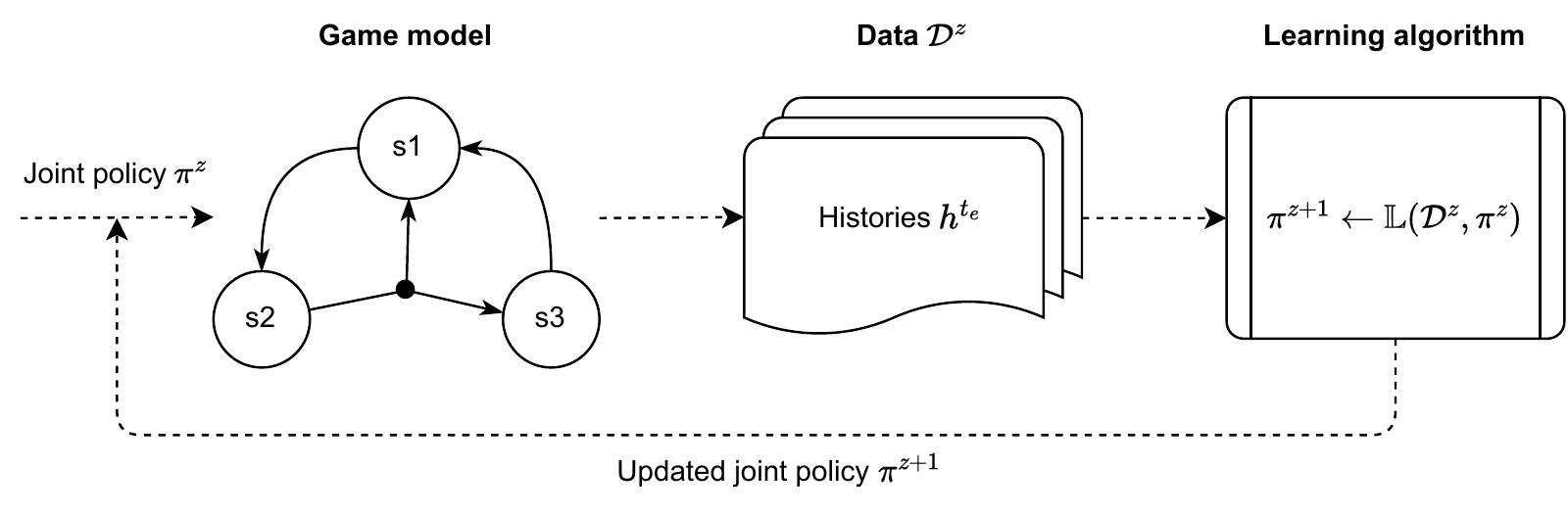
Changing policies
One issue is non-stationarity. To one learner, the other learners are part of the environment. As their policies change, earlier experience loses value. Lowe and colleagues discuss this in Multi-Agent Actor-Critic for Mixed Cooperative-Competitive Environments.
The textbook example below (not YC data) shows two agents learning Rock–Paper–Scissors with WoLF-PHC, each adapting to the other.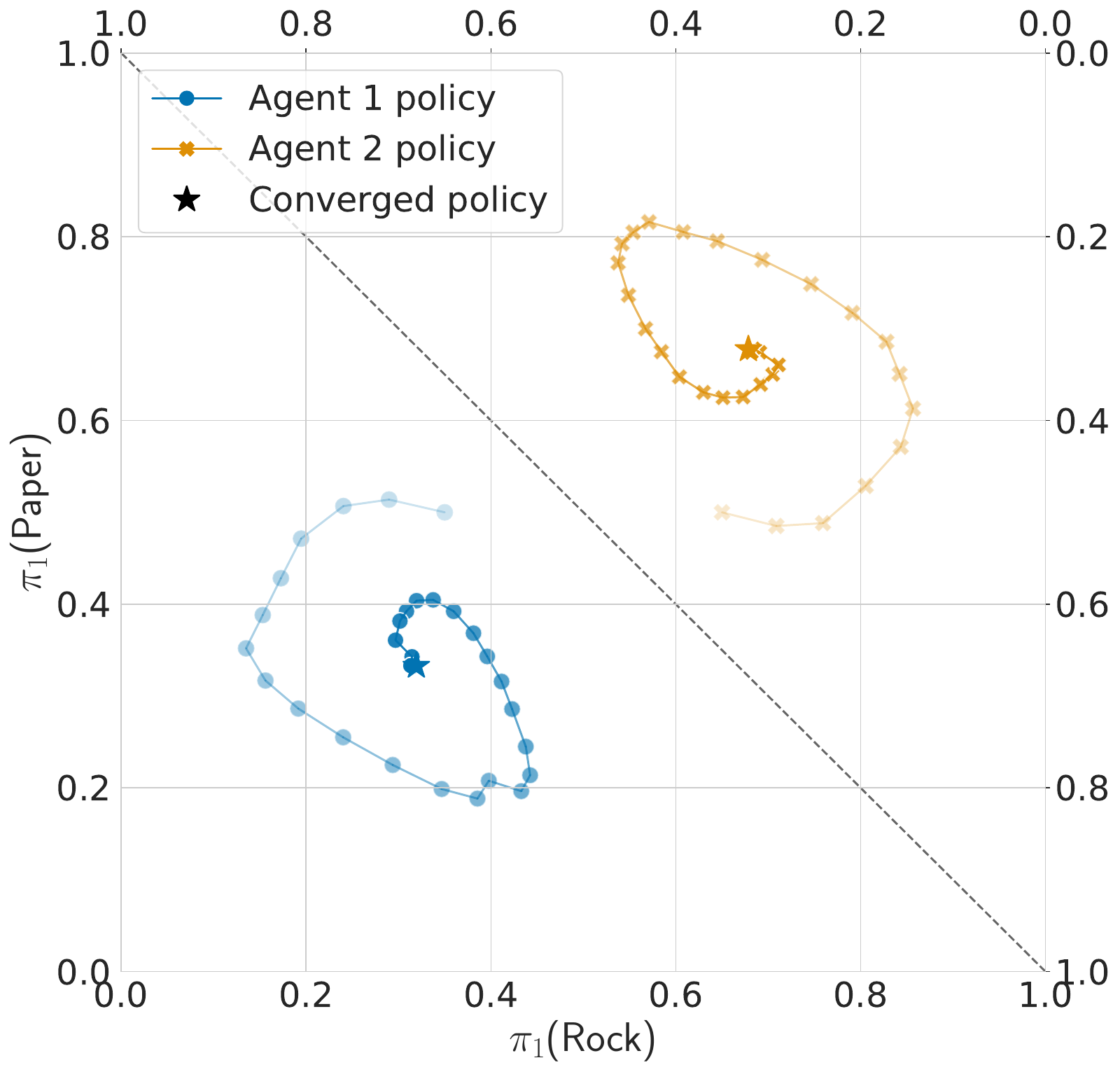
Credit and partial information
Then there is credit. A shared reward tells the team it succeeded, not which actions helped. A team can win because one agent acted well much earlier, another kept a supply chain going, or an opponent blundered; the final score does not separate these. This is the credit-assignment problem tackled by methods such as counterfactual multi-agent policy gradients. Delayed rewards also force the algorithm to link outcomes to actions further back in time.
Partial observation adds more. An agent may see only locally and must act without knowing what teammates know, so two agents with aligned goals can decide differently. Messages help, but can be late, incomplete, or outdated. The free textbook Multi-Agent Reinforcement Learning: Foundations and Modern Approaches covers these questions alongside the game-theoretic foundations.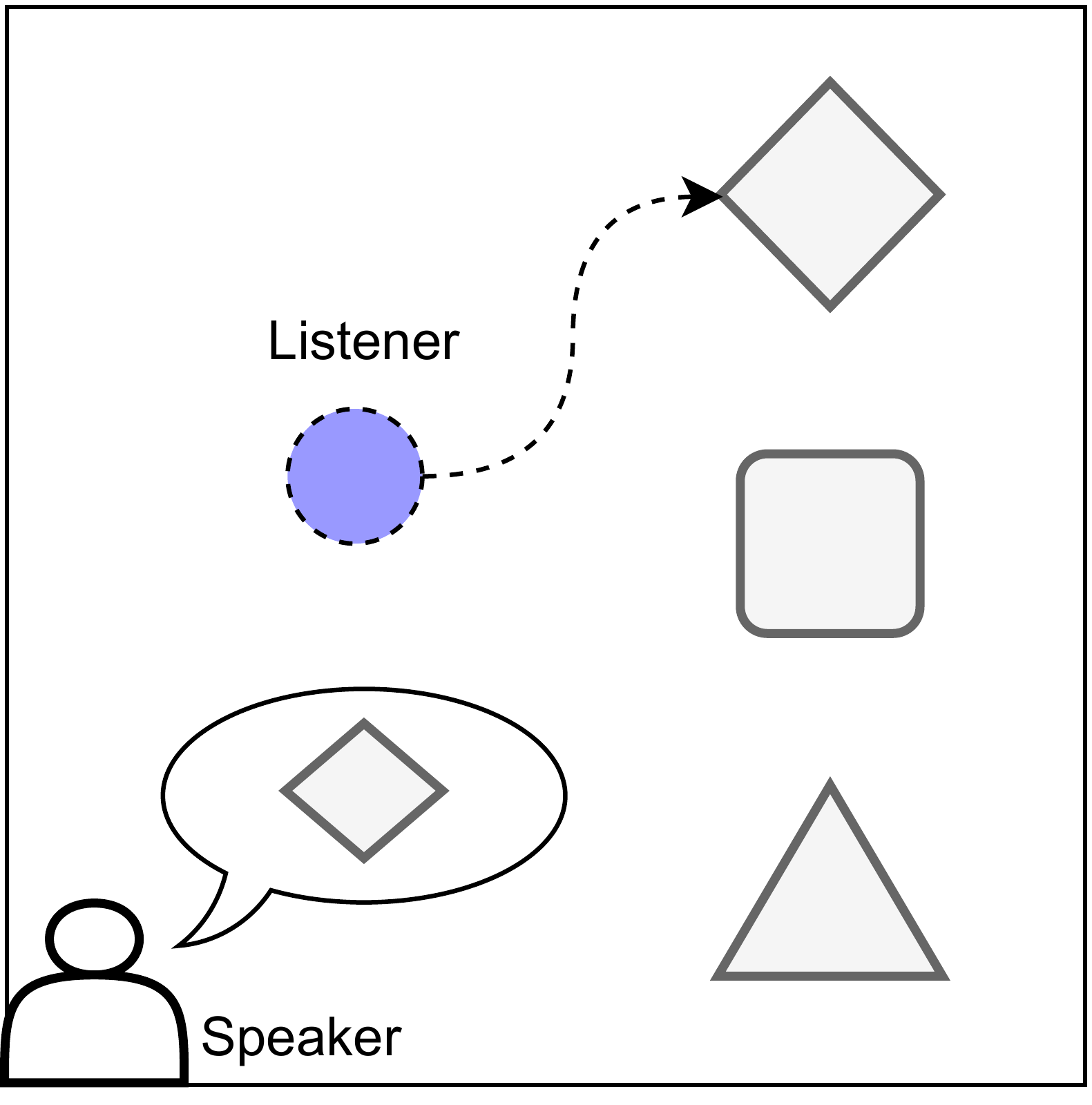
Coordination without online learning
I see related coordination questions in YC’s experiments, but the runs are not evidence of online reinforcement learning. The report describes coding agents using tools, messages, scripts, and memory. Revising a plan or script mid-match does not update a model’s weights.
This matters when reading adaptation. A coding agent can read an error, change a script, and retry while the model stays fixed. In MARL training, the learner updates the policy itself from experience. Both change the next interaction, by different mechanisms.
The overlap is the coordination problem. Who has the information a decision needs? How does one agent’s action change another’s options? Does a local success help the team? These apply whether agents talk in natural language, use learned policies, or both.
Coordination also costs something. More agents mean more interactions and more demand on shared resources. A team may get more done, or spend its effort on conflicts and updates. Message volume alone cannot tell you which; compare the result with the resources used.
The original report has replays, messages, and links to the code. The food-delivery records show a failed handoff up close; the Mindustry matches show coordination under competition. Together, they made MARL easier to picture than a win rate alone.
The diagrams are reproduced without redrawing from the authors’ original lecture materials for Multi-Agent Reinforcement Learning: Foundations and Modern Approaches, with the MIT licence and copyright notice.